
Why You Stayed in a Narcissistic Relationship and Healing?

One of the most common questions people ask themselves after a narcissistic relationship is:
“Why did I stay?
This question often comes with shame, self-blame, and confusion.
But staying in a narcissistic relationship is not a sign of weakness, it is usually the result of very real psychological and relational dynamics.
1. The Relationship Was Not Always Bad
Narcissistic relationships often involve cycles:
Periods of connection, attention, or closeness
Followed by periods of distance, invalidation, or conflict
Those positive moments create hope and emotional attachment, making it difficult to leave.
2. You Were Conditioned to Doubt Yourself
When your thoughts and feelings are repeatedly questioned or dismissed, you begin to rely less on yourself and more on the other person’s version of reality.
This makes it harder to recognize when something is not healthy.
3. You Took on Responsibility That Wasn’t Yours
You may have felt responsible for:
Fixing the relationship
Managing the other person’s emotions
Preventing conflict
This creates a sense that leaving means “failing,” even when the dynamic is unhealthy.
4. Your Past Experiences Played a Role
If you grew up in environments where your needs were not fully met, certain dynamics may feel familiar—even if they are not healthy.
Familiarity can feel like comfort, even when it is harmful.
5. You Were Trying to Make It Work
Many people stay because they are committed, hopeful, and willing to put in effort.
Those qualities are not the problem.
The issue is when those qualities are used in a dynamic that does not allow for mutual growth or accountability.
Moving Forward Without Shame
Instead of asking, “What’s wrong with me?”
A more helpful question is:
“What patterns did I learn—and how do I change them moving forward?”
Recovery involves:
Understanding your patterns without judgment
Rebuilding your sense of self
Learning how to show up differently in relationships
You don’t need to carry shame into your healing process.
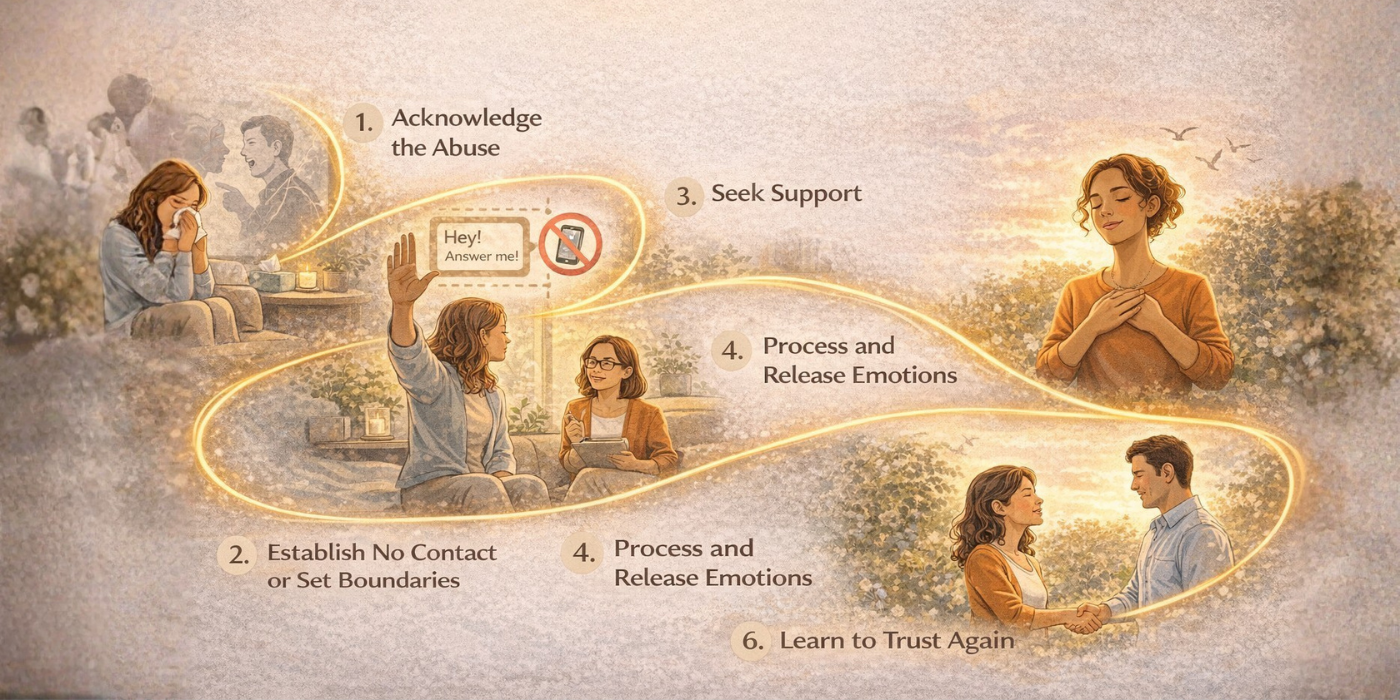
Steps to Healing From Narcissistic Abuse
Healing from narcissistic abuse is not just about moving on from the relationship, it is about rebuilding your relationship with yourself.
1. Acknowledge the Impact
Recognize that what you experienced affected you.
Minimizing or dismissing your experience will keep you stuck. Clarity is the starting point.
2. Reconnect With Your Reality
Begin trusting your thoughts, feelings, and perceptions again.
This involves separating what you know to be true from what you were told or made to believe.
3. Rebuild Your Sense of Self
Focus on who you are outside of the relationship.
Identify your values, needs, and preferences—independent of anyone else.
4. Understand Your Patterns
Explore how you adapted within the relationship.
This is not about blame—it’s about awareness so you can move differently moving forward.
5. Strengthen Emotional Regulation
Learn to manage anxiety, overthinking, and emotional reactivity.
Develop healthier ways to process and respond to your emotions.
6. Develop and Maintain Boundaries
Learn what boundaries look like and how to force them.
This includes tolerating discomfort and letting go of guilt when prioritizing yourself.
7. Build Self-Trust and Confidence
Practice making decisions without excessive reassurance.
Trust is rebuilt through consistent action, not just insight.
8. Shift How You Show Up in Relationships
Apply what you’ve learned to create healthier, more balanced interactions.
Move from reactive patterns to intentional choices.
Healing Is a Process
Recovery takes time, consistency, and intention.
But as your relationship with yourself strengthens, everything else begins to change—how you think, how you feel, and how you engage with others.
We recommend our My Journal as a supportive space to process emotions, reflect on relationship experiences, and gain greater clarity about your healing journey. Consistent journaling can help you better understand your thoughts, recognize patterns, and move forward with greater self-awareness and confidence.
Explore our full collection of journals and self-growth resources to find the tools that best support your healing and personal development journey, Click here.
